
【奥田浩美ブログ】
「奥田さんはまるで5人いるように働いて見えますが、いつ休憩しているのですか?」
昔からこの質問をよく聞かれます。その答えはとてもシンプル。私は10年以上も前から「寝ながら仕事をする」というスタイルを貫いているからです。
一見、怠けているように聞こえるかもしれません。しかし、これは脳と身体のパフォーマンスを最大化するための、私なりの極めて戦略的な選択なのです。10年経ってもまだ時代が追いついてこないようですが、これほど合理的で人間的な働き方はないと、今も確信しています。
次の画像は私が普段仕事をしている環境にとても近い画像です(笑)
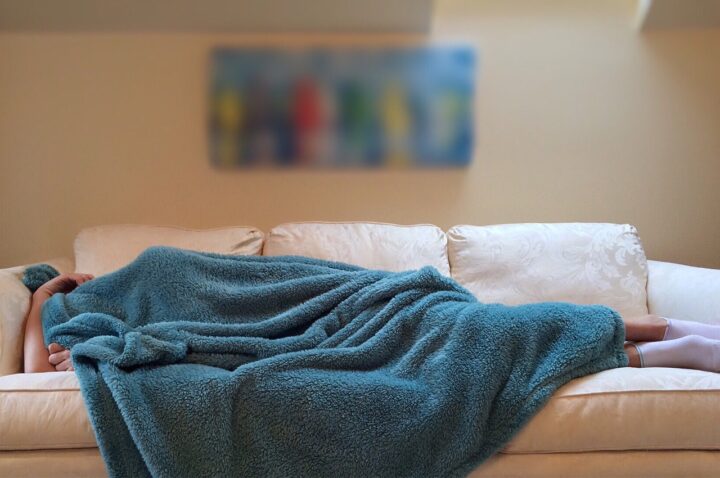
私が「寝ながら・好きな時に」働く、いいことづくめの理由
そもそも私は、社会が画一的に「勤務時間」を決めていること自体にも、ずっと不条理を感じてきました。人間のバイオリズムや集中力の波は、人それぞれ全く違うはずです。
自分の身体が「今じゃない」と伝えてくる時
自分の身体が「今じゃない」と告げているのに、時間だからという理由だけでデスクに向かうのは、非効率そのもの。 だからこそ私は、働く「場所」だけでなく「時間」も、自分の身体の声に委ねたいのです。
その思想が、私の働き方の根幹にあります。
・眠くなるような、つまらない仕事はその時にやらない
・いつでも寝てエネルギーを温存する
・リラックスした状態で脳だけを動かしたい
・過集中気味の自分を労りたい
・自分の身体の落ち着きを感じながら仕事したい
これらの感覚は、科学的にもちゃんと理にかなっているのです。
1. リラックスと「ひらめき」の脳科学
「リラックスした状態で脳だけを動かしたい」— これは、創造性を生み出すための理想的な環境です。
私たちの脳は、リラックスしている時、特にα波という脳波が優位になります。このα波が出ている状態は、いわば「覚醒しているけれど、力みがない」状態。研究でも、この状態が創造的な問題解決や「ひらめき(Aha! moment)」と強く関連していることが示唆されています。
決められた時間に椅子に座って「さあ、集中するぞ!」と意気込むと、脳は緊張し、視野が狭くなりがちです。一方、ソファやベッドで身体の力を抜くことで、脳は自由な発想を広げる準備が整うのです。
2. 「デフォルト・モード・ネットワーク」を味方につける
「いつでも寝てエネルギー温存」と聞くと、単なる「ナマケモノ」に聞こえるかもしれませんね(笑)。しかし、これも脳の重要な機能を活かすための戦略です。
実は、私たちが何もせず「ぼーっとしている」時、脳は活動を停止しているわけではありません。むしろ、デフォルト・モード・ネットワーク(DMN)と呼ばれる脳の領域が活発に働いています。このDMNは、記憶の整理、自己認識、未来の計画など、高度な情報処理を担う「脳のアイドリング機能」とも言えるものです。
いつでも休息(睡眠)に入れる状態を作っておくことは、このDMNの活動を促し、結果的に情報整理や新たなアイデアの結合を助けることに繋がります。こまめな休息は、エネルギーを無駄にしないだけでなく、脳のコンディションを整えるために不可欠なのです。
3. 光と影:運動不足という新たな課題
もちろん、この働き方にも新たな課題は生まれます。それは「運動不足をどう補うか」という、極めて重要な問題です。一日中、ソファやベッドの周りで過ごしていれば、当然、身体はなまります。通勤という強制的な運動すらありませんから。
だからこそ、私は知的生産の時間と、身体を動かす時間を、完全に分離して考えるようにしています。仕事は最もリラックスできる姿勢で脳をフル回転させる。そして、仕事以外の時間で、意識的に運動を取り入れる。
「仕事の時間=身体を拘束される時間」という従来の固定観念を捨てれば、通勤や形式的な会議に奪われていた時間を、丸ごと自分のための運動やメンテナンスに使えるのです。これはデメリットであると同時に、時間を主体的に使えるという大きなメリットの裏返しでもあります。
究極の省エネと、仕事の選別
私の最大の生産性の工夫は、いつでも寝られる状況に自分を置き、本当に重要なこと以外にエネルギーを使わない、究極の省エネ戦略です。
そして、このスタイルは、「寝転がれるほどリラックスした状態で、それでも集中したいと思えるほど面白い仕事しかしない」という、仕事そのものに対する厳しい選別眼も私に与えてくれました。
まだ少し早いのかもしれませんが、私はこれからも、この最高に合理的で人間的な働き方を、自信を持って続けていこうと思います。
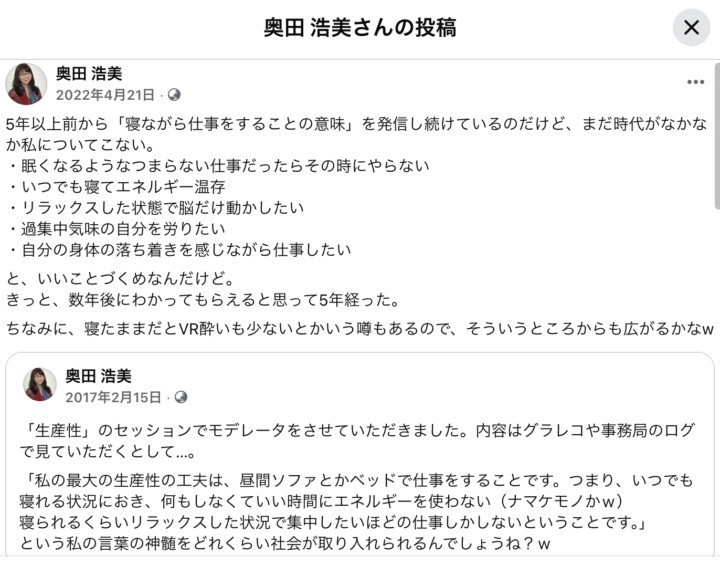
画像は以前から何度もお伝えしている投稿のログ
People often ask me this question: ‘Okuda-san, you seem to be working like five people—when do you actually take a break?’ The answer is very simple: for over ten years, I have been committed to a style of ‘working while sleeping.’
This might sound like laziness at first glance. However, for me, this is an extremely strategic choice designed to maximize the performance of both my brain and body. Ten years later, it seems the world still hasn’t caught up to this concept, but I remain convinced that there is no working style more rational or more human.
The following image is very close to the environment I usually work in (LOL).
The Reasons Why My ‘Working While Sleeping / Whenever I Want’ Style Is Full of BenefitsーFirst and foremost, I have always felt the inherent absurdity in society uniformly deciding on ‘working hours.’ Each person’s biorhythms and waves of concentration should be completely different.
When My Body Tells Me ‘Not Now’
It is the very definition of inefficiency to sit down at a desk simply because the clock says so, when my body is telling me, ‘Not now.’ That is precisely why I want to entrust not only the working ‘location’ but also the ‘time’ to the voice of my own body.
That philosophy lies at the core of my working style.
These feelings—
・Not doing boring, sleep-inducing tasks when I feel tired
・Conserving energy by sleeping whenever I need to
・Wanting to move only my brain while my body is relaxed
・Wanting to care for my tendency toward hyperfocus
・Wanting to work while feeling my body’s calmness
—are, in fact, scientifically sound and make perfect sense.
1. The Neuroscience of Relaxation and the “Aha! Moment”
“I want to move only my brain while my body is relaxed”— this is the ideal environment for generating creativity.When our brain is relaxed, brain waves, particularly $\alpha$ waves, become dominant. The state where these $\alpha$ waves are present is, so to speak, one of “being awake, but without tension.” Research suggests that this state is strongly associated with creative problem-solving and the “Aha! moment.”When you sit down in a chair at a fixed time and resolve to “Okay, now I’m going to focus!”, the brain tends to become tense, and your perspective narrows. In contrast, by relaxing your body on a sofa or in bed, the brain becomes ready to expand into free, unconventional thinking.
2. Utilizing the “Default Mode Network”
Hearing “conserving energy by sleeping whenever I need to” might make me sound like a mere “slacker” (LOL). However, this is also a strategy for leveraging a crucial brain function.
In fact, when we are doing nothing and “zoning out,” the brain is not stopping its activity. Instead, a region of the brain called the Default Mode Network (DMN) is actively working. This DMN can be thought of as the “brain’s idling function,” responsible for high-level information processing such as memory consolidation, self-awareness, and future planning.
Maintaining a state where I can rest (or sleep) at any time encourages the activity of this DMN, which consequently aids in information organization and the synthesis of new ideas. Taking frequent breaks is essential not only to avoid wasting energy but also to optimize the brain’s condition.
3. Light and Shadow: The New Challenge of Insufficient Exercise
Of course, this way of working creates new challenges. The most critical issue is “how to compensate for a lack of exercise.” If you spend all day around the sofa or bed, your body will naturally become sluggish, especially since you don’t even have the forced movement of a commute.
That is why I consciously and completely separate the time for intellectual output from the time for physical activity. For work, I engage my brain at full capacity in the most relaxed posture possible. Then, during non-work hours, I intentionally incorporate exercise.
By discarding the traditional notion that “work time = time your body is confined,” the hours previously stolen by commuting and formal meetings can be entirely dedicated to personal exercise and maintenance. This is a drawback, but it is also the flip side of a massive advantage: the ability to proactively manage my own time.
My greatest productivity hack is the ultimate energy-saving strategy: positioning myself in a situation where I can sleep at any time, thus ensuring I don’t use energy on anything that isn’t truly important.
Furthermore, this style has given me a rigorous eye for work selection, leading to the principle: “I only do work that is interesting enough to make me want to focus, even while I am relaxed enough to lie down.”
It may still be a little ahead of its time, but I intend to continue this supremely rational and human way of working with absolute confidence.
[Image is a log of previous posts that I have shared multiple times.]